RAG Evaluation Frameworks: Mathematical Metrics Behind Ragas and TruLens
Measuring faithfulness, answer relevance, and context recall using LLM-as-a-Judge paradigms.

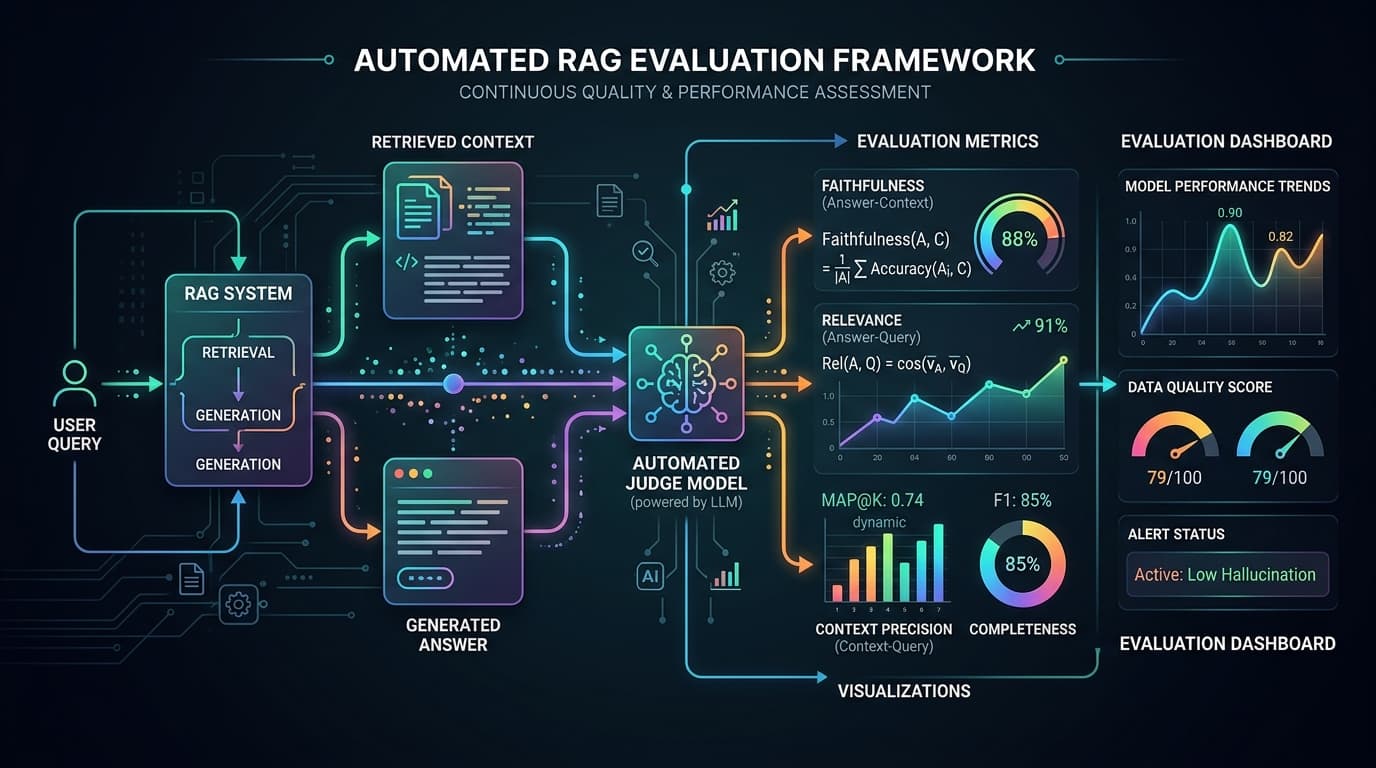
As Retrieval-Augmented Generation (RAG) architectures transition from experimental prototypes to mission-critical systems, developers encounter a persistent challenge: testing. In classical software engineering, testing relies on deterministic inputs yielding predictable outputs. In generative AI, however, the output space is open-ended, non-deterministic, and highly sensitive to subtle updates in prompts, vector database parameters, or underlying models.
Historically, developers relied on manual "vibe-checking"—qualitative review of a handful of queries. While useful in early development stages, vibe-checking fails to scale. A minor tweak to a system prompt might improve response quality for one user query while triggering severe regressions across a hundred others. Furthermore, classical natural language processing metrics like BLEU or ROUGE, originally developed for translation and summarization, fail to capture semantic accuracy. They penalize responses that are factually correct but phrased differently than a reference text, while failing to penalize answers that look structurally sound but are completely hallucinated.
To address these challenges, the AI engineering community has converged on automated, system-level evaluation pipelines. Pioneered by frameworks like Ragas and TruLens, the industry standard is the "LLM-as-a-Judge" paradigm. By using powerful foundation models (like GPT-4o or Claude 3.5 Sonnet) as evaluators, these frameworks translate qualitative quality metrics into quantitative scores. This article explores the mathematical foundations, system architectures, operational benchmarks, and production lessons of Ragas and TruLens.
What Is It?
RAG evaluation frameworks are specialized testing suites designed to measure the performance of each stage in a retrieval-augmented pipeline. Unlike traditional model benchmarks (such as MMLU or GSM8K) which test a base model's static reasoning, RAG evaluation frameworks isolate and analyze the dynamic interaction between:
- The incoming user query
- The retrieved context documents
- The generated output response
At the core of this methodology is the RAG Triad (popularized by TruLens) or the RAG Assessment Triangle (defined by Ragas). The triad breaks down the evaluation into three distinct, independent relationships:
                  [ Query ]
                 /         \
   Context      /           \      Answer
   Relevance   /             \    Relevance
              /               \
             v                 v
      [ Retrieved ] -------> [ Generated ]
        Context   Faithfulness  Answer
- Context Relevance (Query vs. Retrieved Context): Did the retrieval system fetch the right information? It measures the proportion of retrieved chunks that are actually relevant to answering the query.
- Faithfulness or Groundedness (Retrieved Context vs. Generated Answer): Is the response factually grounded in the retrieved sources, or does it contain hallucinations?
- Answer Relevance (Query vs. Generated Answer): Does the response directly address the user's question, or does it include redundant, off-topic, or incomplete information?
By breaking down the evaluation into these three segments, developers can isolate the exact source of a system failure. If the Faithfulness score is high but Answer Relevance is low, the retrieval system succeeded, but the generator LLM failed to structure the response correctly. If Context Relevance is low, the vector store retrieval parameters or embedding models must be optimized.
Why It Matters
Implementing automated evaluation is not just a theoretical exercise; it has major technical and business implications. In production environments, RAG pipelines are highly dynamic. Swapping an embedding model, altering the chunking strategy, adjusting metadata filtering, or upgrading the generative LLM can cause silent failures.
For instance, optimizing a retrieval system using Hybrid Search, Reciprocal Rank Fusion, and Cross-Encoder Re-ranking can dramatically change the order and quality of retrieved contexts. Without quantitative benchmarks, there is no way to verify whether the re-ranker is improving downstream generation quality or introducing noise. Similarly, modifying document ingestion parameters through Advanced RAG and Hierarchical Parsing (such as parent-child retrievers) will directly affect context precision. Without metrics to measure how these changes impact the generator LLM's faithfulness, developers are left guessing.
Furthermore, while real-time Guardrails in Production Validation at Scale can intercept unsafe or malformed outputs in milliseconds during live user sessions, they do not provide a systemic view of evaluation drift. Downstream batch evaluation runs complement inline guardrails by auditing the entire system's behavior over time, identifying systematic weaknesses, and enabling regression testing in CI/CD pipelines before code is ever merged.
How It Works
The "LLM-as-a-Judge" paradigm works by utilizing a powerful foundation model as an evaluator. Rather than asking the judge to assign a raw rating (e.g., "rate this answer from 1 to 10"), which is highly subjective and prone to drift, frameworks like Ragas and TruLens decompose each metric into a multi-step algorithmic pipeline.
Step 1: Claim/Statement Extraction (Segmentation)
Evaluating a long, complex text directly is difficult. The framework first instructs the LLM judge to break the text (either the generated answer or the retrieved context) down into individual, self-contained semantic assertions.
For example, given the generated answer:
- "Ragas is an open-source evaluation framework. It was released in 2023 and uses LLM-as-a-judge."
The LLM judge extracts the following atomic claims:
Ragas is an open-source evaluation framework.Ragas was released in 2023.Ragas uses LLM-as-a-judge.
Step 2: Source Verification (Attribution)
Next, the framework prompts the judge LLM to verify whether each extracted claim is supported by the source document. The prompt template provides the source text (e.g., the retrieved context) and the list of claims, asking the model to output a binary decision (YES, NO, or N/A) along with a clear reasoning trace.
Step 3: Score Calculation
Finally, the framework compiles these binary classifications into a mathematical ratio, mapping the result to a standardized scale between 0.0 and 1.0.
           +----------------------------------------+
           |           Generated Answer             |
           +----------------------------------------+
                                |
                                v
           +----------------------------------------+
           |          LLM Judge Segmenter           |
           +----------------------------------------+
                                |
                                v
         [ Claim A ]       [ Claim B ]       [ Claim C ]
              |                 |                 |
              v                 v                 v
           +----------------------------------------+
           |          LLM Judge Verifier            |
           |       (Checks against Context)         |
           +----------------------------------------+
              |                 |                 |
              v                 v                 v
            [ YES ]           [ YES ]           [ NO ]
              \-----------------+-----------------/
                                |
                                v
                  Faithfulness Score = 2 / 3 = 0.67
Architecture
Understanding how evaluation fits into the broader application lifecycle is critical. Evaluation runs are divided into two main categories:
- Offline Evaluation (CI/CD Gates): Run on a fixed "golden dataset" of queries, contexts, and ground-truth answers whenever prompts, codebase logic, or retrieval configurations change.
- Online Evaluation (Production Monitoring): Run asynchronously on live production logs to track user experience, drift, and detect anomalies.
The evaluation pipeline's architecture is shown in the following data flow:
Offline Dev/CI Gate:
[ Golden Dataset ] -> [ RAG Pipeline ] -> [ Generated Answers ] -\
                                                                  \---> [ Ragas Evaluator ] -> [ Score Validation ] -> [ Build Pass/Fail ]
[ Query & Ground ] ----------------------------------------------/

Online Production Monitoring:
[ User Query ] -> [ RAG Pipeline ] -> [ Live Answer ]
                         |
                         v
                [ OpenTelemetry Trace ] -> [ Asynchronous Queue ] -> [ TruLens Evaluator ] -> [ SQL/DB Dashboard ]
Ragas vs. TruLens: Architectural Tradeoffs
While both frameworks share the goal of evaluating RAG systems, their architectures are designed for different entry points:
- Ragas: Built as an offline metrics library. It is data-frame native, meaning you pass in a dataset containing queries, retrieved contexts, generated answers, and ground-truths, and Ragas computes the metrics. It is highly optimized for CI/CD unit testing and offline benchmarking.
- TruLens: Built as an observability and instrumentation platform. It uses python decorators and wrapper classes to instrument your application code. As your code runs, TruLens captures execution traces (such as retriever inputs/outputs, model calls, latency, token counts) and logs them to a database. It then executes evaluations asynchronously on these logs.
Table 1 provides a comparison of their capabilities.
| Feature | Ragas | TruLens |
|---|---|---|
| Primary Focus | Standardized, offline metrics calculation | Code instrumentation and production tracing |
| Instrumentation Method | Explicitly pass data structures (dataframes) | Decorators and wrappers (tru_llama, tru_chain) |
| Data Collection Protocol | Manual collection / Pandas integration | OpenTelemetry (OTEL) native tracing |
| Storage Engine | None (in-memory, user manages persistence) | Built-in SQLite, PostgreSQL, or Snowflake databases |
| Dashboard | No built-in dashboard (external UI needed) | Streamlit dashboard (leaderboard, trace viewer) |
| Metric Execution | Synchronous batch calculation | Asynchronous or background feedback functions |
| License | Apache 2.0 | Apache 2.0 |
Detailed Mathematical Metrics
The core value of Ragas and TruLens lies in their mathematical formulations of evaluation metrics. Let us analyze the primary metrics in detail, representing the logic and equations clearly using standardized code blocks.
1. Faithfulness (Groundedness)
Faithfulness measures if the generated response is strictly derived from the retrieved context. It is a precision-oriented metric designed to detect hallucinations.
Algorithm:
- The judge model extracts the set of claims
Cfrom the generated answerA. - For each claim
cinC, the judge determines ifccan be inferred from the retrieved contextK. - The supported claims are collected in set
S.
Formula:
Faithfulness = |S| / |C|
Where |S| is the number of claims supported by the context, and |C| is the total number of claims extracted from the response. A score of 1.0 indicates perfect grounding; any score below 1.0 flags hallucination risk.
2. Answer Relevance
Answer Relevance evaluates whether the generated response directly answers the user's prompt without introducing off-topic or redundant details. It does not evaluate factual correctness (handled by Faithfulness), but rather structural and semantic alignment.
To calculate this without reference ground-truth, Ragas uses a reverse-engineering approach:
- The framework feeds the generated answer
Ato the judge model. - The judge model is asked to generate
Mhypothetical questions (typicallyM = 3) that would naturally lead to this answerA. - The framework computes text embeddings for the hypothetical questions and the original user query
Q. - The cosine similarity between each generated question embedding and the original query embedding is calculated.
Formula:
Answer Relevance = (1 / M) * Sum(i=1 to M) cos(E_g_i, E_o)
Where E_g_i is the vector embedding of the i-th generated hypothetical query, and E_o is the vector embedding of the original user query.
3. Context Recall
Context Recall measures the recall of the retrieval system against a known "ground truth" answer. It determines whether the system retrieved all the necessary facts. This is a reference-based metric used in offline testing.
Algorithm:
- The framework extracts the ground-truth answer
Gand decomposes it into individual factual statementsF. - For each statement
finF, the judge model checks if it is present within the retrieved context chunksK. - The successfully retrieved facts are counted.
Formula:
Context Recall = (Facts in G present in K) / (Total Facts in G)
4. Context Precision
Context Precision measures whether the relevant chunks retrieved are positioned at the top of the search results. This is critical for systems that pass retrieved contexts to a generation LLM, as LLMs suffer from "lost in the middle" phenomena, where they pay less attention to chunks buried in the middle of a large prompt context.
Algorithm:
- Given a list of retrieved chunks
K = [k_1, k_2, ..., k_n], the judge evaluates each chunkk_ifor relevance to the original queryQ. - Let
v_ibe1ifk_iis relevant, and0otherwise. - Compute the Precision at each rank
i(denoted asPrecision@i). - Average these precision values, weighted by the relevance of each chunk.
Formula:
Precision@i = (Sum(j=1 to i) v_j) / i
Context Precision = (1 / R) * Sum(i=1 to N) (Precision@i * v_i)
Where R is the total number of relevant chunks in the top N retrieved documents. If all relevant chunks are pushed to the top of the context window, Context Precision is 1.0.
Benchmarks and Comparisons
Running automated evaluations introduces operational overhead. Using an LLM as a judge adds execution latency and API costs. When selecting a framework and judge model, developers must balance evaluation latency, API costs, memory consumption, and alignment accuracy with human reviewers.
Operational Benchmarks
Table 2 highlights the typical operational performance of Ragas, TruLens, and DeepEval when evaluating a standard batch of 100 queries using GPT-4o as the judge.
| Operational Metric | Ragas (v0.2.x) | TruLens (v2.8.0) | DeepEval (v0.9.x) |
|---|---|---|---|
| Execution Latency (100 runs) | ~180 seconds (serial) | ~35 seconds (parallel) | ~25 seconds (parallel) |
| Avg. API Cost (per 100 evaluations) | ~$2.50 | ~$2.80 | ~$2.45 |
| Human Agreement (Spearman Rho) | 0.82 | 0.79 | 0.81 |
| Memory Overhead (Framework) | ~120 MB | ~450 MB (database engine) | ~140 MB |
| CI/CD Optimization | Excellent | Moderate | Excellent |
Note: In TruLens v2.8.0, the introduction of parallel batch evaluations improved performance by up to 5.4x, reducing execution latency from several minutes to under 45 seconds for typical evaluation sets.
Judge Model Tradeoffs
The choice of the underlying LLM judge determines the reliability of the scores. While GPT-4o and Claude 3.5 Sonnet show high alignment with human expert annotators, they are expensive to run continuously. Smaller open-source models, such as Llama-3-8B-Instruct, offer significant cost savings but suffer from reduced reasoning capabilities, leading to high false-positive rates.
Table 3 compares the performance and costs of different judge models.
| Judge Model | Human Alignment (Spearman) | Avg. Latency per Query | Cost per 1k Claims | Recommended Usage |
|---|---|---|---|---|
| GPT-4o | 0.86 | ~1.2 seconds | $5.00 / 1M input tokens | Production auditing, baseline calibration |
| Claude 3.5 Sonnet | 0.88 | ~1.5 seconds | $3.00 / 1M input tokens | High-precision medical & scientific RAG |
| Llama-3-70B-Instruct | 0.78 | ~2.1 seconds | $0.80 / 1M input tokens (Hosted) | Enterprise on-premise evaluation gates |
| Llama-3-8B-Instruct | 0.52 | ~0.8 seconds | $0.15 / 1M input tokens (Hosted) | Quick local drafting, initial claim filtering |
Production Deployment Considerations
Deploying RAG evaluations in enterprise production environments requires solving several operational scaling challenges.
1. Continuous Evaluation in CI/CD Gates
To prevent regressions, configure evaluation suites to run automatically during code integration. Rather than running the evaluation on every git commit (which is costly), trigger the suite when a pull request modifies prompt files, database parsing logic, or retriever code.
- Maintain a curated "Golden Dataset" of 50 to 100 representative query-context-ground truth pairs.
- Define strict threshold limits. For example, block a release if the average Faithfulness score drops below
0.85or if Context Recall drops by more than5%.
2. Live Production Sampling
Running evaluations on every live transaction in a high-traffic application is impractical due to API costs and latency overhead.
- Implement asynchronous evaluation: Route production traces (inputs, retrieved chunks, outputs) to a message queue (e.g., RabbitMQ or AWS SQS).
- Evaluate a sampled subset of traffic (typically between
1%and5%of total queries). - Prioritize evaluating queries that receive negative user feedback (thumbs down), as these represent high-value failure signals.
3. OpenTelemetry (OTEL) Standardization
In TruLens v2.8.0, the framework deprecated proprietary logging wrappers in favor of standard OpenTelemetry semantic conventions. By instrumenting your code with OTEL spans, you capture traces in a vendor-neutral format. These traces can be exported directly to APM tools (such as Datadog or Jaeger) while being duplicated to TruLens or Ragas for downstream scoring, minimizing instrumentation code churn.
4. Warehouse-Native Evaluation
For enterprise architectures dealing with strict data privacy guidelines, data egress (sending logs to external APIs) is a bottleneck. TruLens v2.7.0 introduced Snowflake native application support. This allows evaluation feedback functions to run directly inside the customer's secure Snowflake environment using Snowflake Cortex LLMs, ensuring that sensitive customer data never leaves the corporate data boundary.
Common Mistakes
When implementing RAG evaluation pipelines, engineers frequently fall into several pitfalls:
1. The "Self-Evaluating" Loop
A common architectural error is using the same LLM for both generation and evaluation (e.g., using GPT-4o to generate answers and using the exact same GPT-4o instance as the evaluation judge). LLMs exhibit a pronounced self-bias, consistently scoring their own outputs higher than those of other models.
- Solution: Always use a different model family for evaluation (e.g., if generating with Llama-3, evaluate with Claude 3.5 Sonnet), or use a highly distinct system prompt template for the evaluator.
2. Blindly Trusting LLM Scores
automated metrics are approximations. Teams often configure CI/CD pipelines to block builds based on arbitrary thresholds without first validating that a score drop corresponds to a real decrease in quality.
- Solution: Run a manual calibration step. Have human domain experts rate a subset of 100 outputs, and calculate the correlation (Spearman's Rho) between human ratings and LLM judge ratings. Calibrate prompts until correlation exceeds
0.75.
3. Out-of-Domain Evaluation Failure
Standard evaluation prompts assume general-domain English text. If your RAG pipeline operates in a highly specialized field (such as law, pharmacy, or advanced materials science), general-purpose judges will fail. As detailed in the RSC Domain RAG Study, a general-purpose judge LLM often fails to recognize subtle but critical factual errors in scientific chemical compound synthesis descriptions.
- Solution: Inject few-shot examples into the evaluation prompts, showing the judge how to evaluate complex domain-specific terminology and mathematical formulas.
Lessons From Production Deployments
Operating RAG evaluation systems at scale yields critical engineering lessons that are rarely covered in basic documentation:
1. The Decay of Golden Datasets
Golden datasets are not static. As your product features grow and the underlying database content updates, a golden dataset created six months ago will become stale. If the product starts supporting new query types, your offline evaluations will suffer from dataset drift, showing high scores that fail to reflect poor live performance. Teams must schedule quarterly updates to refresh at least 20% of their golden datasets with real-world user queries.
2. Handling Non-Deterministic Judge Failures
Evaluation models are themselves non-deterministic LLMs. In production, a judge model might output invalid JSON, timeout, or return NaN (Not a Number) values. If a CI/CD build script depends on a synchronous Ragas run, a single timed-out API call can block an entire deployment.
- Solution: Implement robust fallback parsing logic, retry decorators (such as Tenacity in Python), and default to the last known stable evaluation score if a judge run fails.
3. The "Grounding Gap"
A RAG system can be perfectly faithful to the retrieved context, resulting in a Faithfulness score of 1.0, even if the answer is completely wrong. This occurs when the retriever fetches incorrect or stale documents, and the generator LLM accurately summarizes this incorrect information. Tracking Faithfulness alone creates a false sense of security.
- Solution: You must track the full RAG triad. If Context Recall is low, the retrieved context is wrong, exposing the grounding gap.
What Most Articles Miss
While standard guides focus on API usage, they omit the rigorous alignment math and operational optimization needed to make LLM-as-a-judge viable at enterprise scale.
1. Human-Judge Alignment Mathematics
To prove that your automated judge is reliable, you must mathematically calculate its alignment with human annotators. The two standard metrics are Cohen's Kappa (for binary categorical decisions like "Is Supported: YES/NO") and Spearman's Rank Correlation Coefficient (for continuous scores between 0 and 1).
Cohen's Kappa is calculated using the formula:
Kappa = (p_o - p_e) / (1 - p_e)
Where p_o is the relative observed agreement between the human and the LLM judge, and p_e is the hypothetical probability of chance agreement. A Kappa score between 0.61 and 0.80 indicates substantial agreement, while scores above 0.80 indicate near-perfect alignment.
For continuous evaluation scores, use Spearman's Rank Correlation:
Spearman Rho = 1 - (6 * Sum(d_i^2)) / (n * (n^2 - 1))
Where d_i is the difference between the ranks of the human score and the LLM judge score for the i-th query, and n is the total number of evaluated queries.
2. The Reference Leakage Problem in Context Recall
When using an LLM judge to evaluate Context Recall, the judge is provided with the Ground Truth G and the Retrieved Context K. However, large foundation models suffer from parametric memory leakage. Because the judge model already "knows" the answer to general questions from its pre-training data, it will frequently label a fact as "successfully retrieved from context" even if that fact was entirely missing from K, simply because the model's internal weights contain the fact.
- Solution: Explicitly strip any identifying metadata or broad knowledge terms from the query when prompting the judge, or restrict the judge's context checking to a strict substring or semantic vector alignment step before prompting.
3. Cost Amortization via Prompt Caching
LLM-as-a-judge requires sending large system prompt templates and context documents on every evaluation query. This can lead to excessive API costs.
- Solution: Leverage LLM providers that support Prompt Caching (such as Anthropic Claude or Google Gemini). By structure-designing your evaluation batch so that the large system prompt and retrieved contexts are placed at the beginning of the API request payload, subsequent evaluation queries can hit the prompt cache, reducing input token costs by up to
90%and decreasing latency by50%.
Best Practices
To build a robust evaluation pipeline, adhere to the following best practices:
- Isolate Judge Models: Do not use the generation LLM as the evaluator. Utilize stronger models (such as GPT-4o or Claude 3.5 Sonnet) as your judges.
- Standardize on OpenTelemetry: Instrument your RAG code using OpenTelemetry. This ensures your trace logging is decoupled from the evaluation framework, allowing you to switch between TruLens, Ragas, or custom dashboards without rewriting your application.
- Calibrate with Human Annotations: Never trust a metric out of the box. Manually annotate 100 queries, calculate Cohen's Kappa, and tune your evaluation prompts until alignment exceeds
0.75. - Implement Sampling in Production: Evaluate a random sample of
1%to5%of live traffic to monitor quality drift without incurring excessive API costs. - Use Prompt Caching: Group your evaluation runs in batches and leverage prompt caching to minimize latency and input token costs.
- Deploy evaluations as CI/CD blockers: Configure your git workflow to run offline evaluation tests on pull requests that modify search retrieval parameters, blocking merges if scores regress.
FAQ
1. What is the main difference between Ragas and TruLens?
Ragas is an offline, dataframe-native library designed to compute metrics on predefined datasets (ideal for CI/CD gates). TruLens is an observability-first framework that instruments your running code, captures execution traces, and runs feedback evaluations asynchronously on those traces.
2. Can I use a local open-source LLM (like Llama-3-8B) as an evaluation judge?
While possible, small models (under 13B parameters) lack the complex reasoning required to accurately segment text and assess semantic alignment. They exhibit high false-positive rates. Llama-3-8B can be used for basic claim segmentation, but a larger model like Llama-3-70B or GPT-4o is recommended for the final verification step.
3. How does LLM-as-a-judge handle long retrieval contexts?
When retrieving large quantities of text, LLMs can experience "lost in the middle" effects, overlooking crucial facts. Ragas and TruLens mitigate this by breaking the context and generated answers into atomic claims before evaluation, analyzing each claim individually.
4. What is the operational cost of running Ragas in CI/CD?
Using GPT-4o as a judge, evaluating a standard regression test suite of 100 queries costs approximately $2.50 in API tokens and takes under 40 seconds when executed in parallel.
5. How do I solve the "self-evaluation bias"?
Avoid using the same LLM model for both response generation and evaluation. If your application uses GPT-4o for generation, use Claude 3.5 Sonnet or an open-source model like Llama-3-70B-Instruct for evaluation.
6. How does TruLens integrate with enterprise data warehouses?
TruLens v2.7.0 introduced native integration with Snowflake, allowing teams to run evaluations directly inside their secure data warehouse environment using warehouse-native LLMs, preventing sensitive data egress.
7. What is context precision vs. context recall?
Context Recall measures whether the retrieval system found all the necessary facts (calculated against a ground-truth reference). Context Precision measures whether the retrieved relevant documents are placed at the top of the search results, preventing the generator LLM from losing information in the middle of a large prompt.
8. How does OpenTelemetry benefit RAG evaluation?
OpenTelemetry provides a standardized, vendor-neutral framework for tracing application execution. By instrumenting your code with standard OTEL spans, you can capture execution traces once and export them to multiple evaluation tools or APM monitoring platforms without modifying your application logic.
9. Can Ragas evaluate agentic workflows?
Yes. Modern evaluations utilize trace tracking to evaluate multi-step agent trajectories. Recent research in 2026 has expanded Ragas and TruLens to score intermediate tool-calling accuracy, path routing, and planning steps rather than just the final response.
10. How do I establish a baseline for evaluation metrics?
Begin by running a manual annotation run on 100 representative queries. Compare the human scores against the automated metrics to establish a baseline threshold. Use this baseline to tune prompt templates, retrieval weights, and chunking parameters.
Key Takeaways
- The RAG Triad is Essential: Never rely on a single evaluation score. Evaluate Context Relevance, Faithfulness, and Answer Relevance independently to isolate system bottlenecks.
- LLM-as-a-Judge Deconstructs Texts: Do not ask LLM judges for general ratings. Structure evaluations to extract atomic claims first, then verify each claim individually.
- Calibrate to Human Baselines: Calculate alignment metrics like Cohen's Kappa or Spearman's Rho. If your automated judge does not align with human expert judgments (correlation > 0.75), your metrics are unreliable.
- Standardize on OpenTelemetry: Decouple trace collection from evaluation logic by using standard OTEL spans, ensuring long-term architectural flexibility.
- CI/CD Integration Prevents Regressions: Run offline evaluation suites on a versioned golden dataset as a pull request blocker when changing prompts, chunking strategies, or model parameters.
- Optimize Costs with Prompt Caching: Structure batch evaluations to take advantage of prompt caching, reducing LLM judge API costs by up to 90%.
- Monitor the Grounding Gap: Ensure you evaluate retrieval recall alongside generation faithfulness; a generated response can be perfectly grounded in retrieved text even if the retrieved text is factually incorrect.
- Keep Golden Datasets Updated: Refresh golden datasets quarterly (at least 20% renewal rate) to avoid dataset drift and ensure tests align with evolving product features.