Stateful AI Multi-Agent Systems: LangGraph vs Semantic Kernel
Handling cyclic execution loops, agent coordination, and long-term memory persistence.

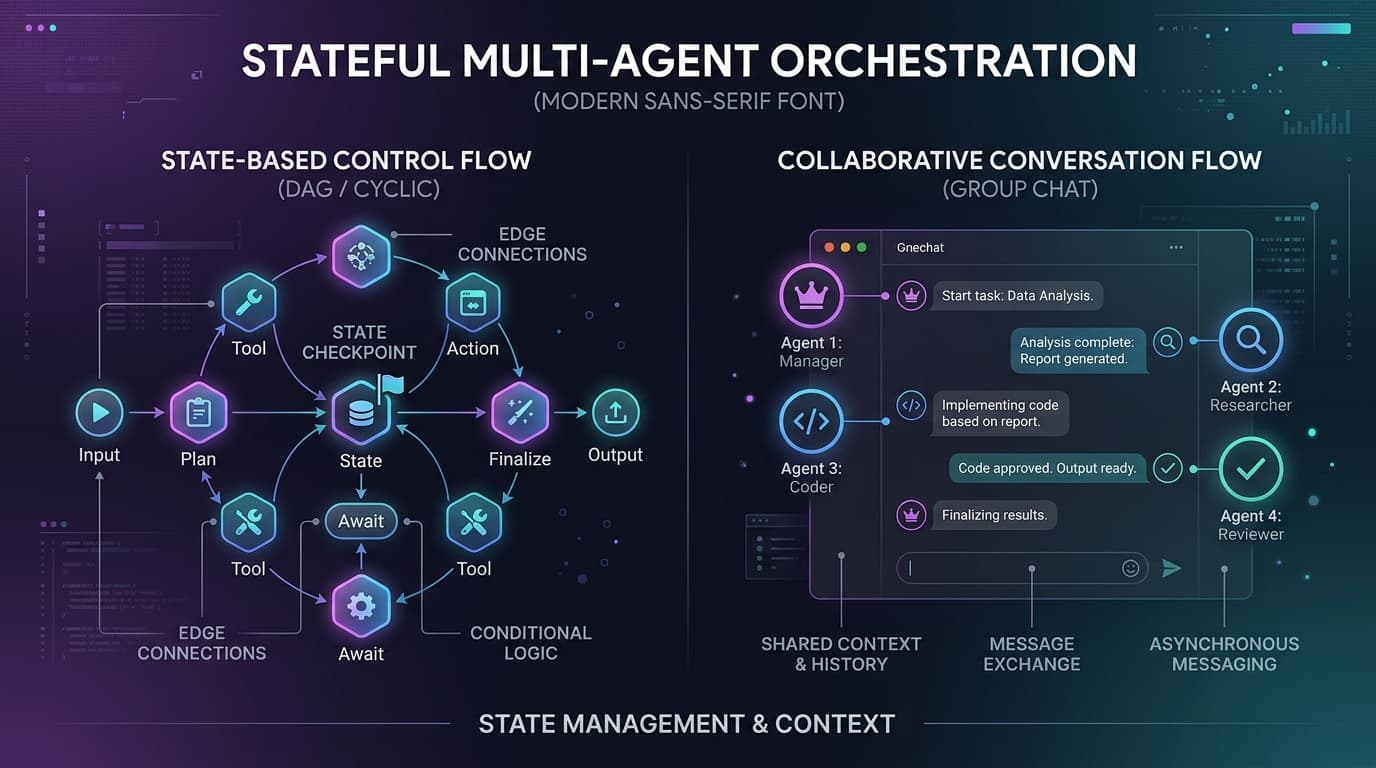
As Large Language Models (LLMs) transition from static, single-turn query responders to active, autonomous software engineers, the architecture of the systems wrapping them has evolved dramatically. Early agent frameworks operated on simple, linear pipelines. They would accept an input, run a sequential chain of prompts, and return an output. However, real-world workflows are rarely linear. They require cycles—loops where an agent can execute an action, observe the feedback from a compiler, database, or API, and dynamically decide to refine its plan and re-execute.
Building resilient, cyclic multi-agent systems at enterprise scale presents severe challenges. The system must manage a shared execution state, coordinate handoffs between highly specialized agents, handle concurrency, and persist memory over days or weeks of asynchronous execution.
For technical teams evaluating the landscape in 2026, two primary ecosystems have emerged to address these challenges: LangGraph (developed by LangChain) and Semantic Kernel (recently unified by Microsoft with AutoGen to form the Microsoft Agent Framework). Selecting the right orchestrator is a critical architectural decision that dictates the runtime predictability, memory footprint, and development velocity of your AI team.
This guide provides an in-depth, comparative analysis of LangGraph and the Microsoft Agent Framework (formerly Semantic Kernel), examining their state management architectures, loop-control mechanisms, agent coordination topologies, and production persistence patterns.
What Is It?
To evaluate these frameworks, we must first establish a formal understanding of their core building blocks.
Stateful Multi-Agent Systems
A stateful multi-agent system is a software architecture where multiple autonomous AI agents—each equipped with specialized tools, prompts, and roles—collaborate to solve complex, non-linear tasks. The system is characterized by a shared, mutable state that tracks the history of the conversation, tool outputs, and intermediate decisions. Crucially, the execution flow is cyclic: agents can loop back to previous states, trigger recursive sub-tasks, and self-correct based on runtime feedback.
LangGraph
LangGraph is an orchestration framework developed by LangChain designed specifically for building stateful, multi-actor applications using graphs. Officially released as stable in its LangGraph v1.0 Release in October 2025, and majorly updated through the LangGraph v1.2 Release in May 2026, LangGraph models agentic behavior as a collection of nodes (representing execution steps or agent turns) and edges (representing the flow of control and data between nodes).
State in LangGraph is managed through a centralized schema that is updated via deterministic "reducers" when nodes complete execution. Checkpointing is built-in as a first-class citizen, allowing the system to pause, resume, fork, and inspect the state graph at any execution step.
Semantic Kernel & Microsoft Agent Framework
Semantic Kernel began as an enterprise-grade SDK developed by Microsoft to integrate LLMs into traditional C# and Java applications. However, as the industry shifted towards multi-agent orchestration, Microsoft initiated a convergence between Semantic Kernel and AutoGen. On April 3, 2026, Microsoft officially released the Microsoft Agent Framework 1.0, merging Semantic Kernel’s kernel-and-plugin architecture with AutoGen’s multi-agent routing engines.
The Microsoft Agent Framework organizes collaboration through AgentGroupChat environments. Rather than using an explicit graph structure, it uses agent-specific execution settings, prompt-based SelectionStrategy instances, and regex- or prompt-based TerminationStrategy instances to orchestrate multi-agent conversations.
Why It Matters
Implementing autonomous agents without a robust stateful framework is highly dangerous. As agents are granted tool access (such as write permissions to SQL databases or cloud hosting APIs), the system must be tightly constrained and observable.
The Need for Cyclic Graph Orchestration
Standard Directed Acyclic Graphs (DAGs) are insufficient for complex tasks like autonomous code generation, multi-stage debugging, or interactive research. For example, if an agent writes code that fails a unit test, a static DAG cannot loop back to the coding node to fix the error. The system requires a cyclic graph where the test runner node can route execution back to the editor node, carrying the error logs in the shared state.
Without formal graph control, managing these loops using raw code leads to "spaghetti orchestration"—fragile, nested while loops that are impossible to debug, monitor, or test.
Ecosystem Alignment and Language Parity
Choosing between these frameworks is often dictated by your existing enterprise infrastructure:
- The Python/TypeScript Stack: Teams that are "AI-native" and heavily utilize Python or TypeScript for machine learning typically align with LangGraph. It integrates seamlessly with the vast ecosystem of Python libraries, LangChain utilities, and data science frameworks.
- The C#/.NET Stack: Enterprise organizations running on Microsoft Azure and C#/.NET backend services almost universally select the Microsoft Agent Framework. In these environments, compiling code, utilizing dependency injection, and conforming to strict corporate security patterns (like OAuth2 and Microsoft Entra ID) are paramount. The Microsoft Agent Framework offers first-class C# support, allowing AI agents to be compiled directly into existing enterprise web services.
Human-in-the-Loop Controls
In production, agents cannot be left completely unsupervised. An autonomous agent tasked with processing customer refunds must pause and request human authorization before calling a payout API.
LangGraph provides built-in "interrupts" that pause graph execution before a specific node runs, saving the state to a persistent database. A human can then review the proposed action and resume execution, or even rewrite the agent's proposed state—a feature known as "time-travel." The Microsoft Agent Framework handles this via custom middleware filters and event handlers, requiring developer-written logic to intercept chat events.
For more details on designing self-correcting validation pipelines, see our guide on Guardrails and Production LLM Validation at Scale.
How It Works
To understand how these orchestrators manage agent interactions, we must analyze their execution traces, state schemas, and persistence models.
Cyclic Execution Loop Mechanics
1. LangGraph State Channels and Reducers
In LangGraph, the graph state is represented as a typed dictionary (or Pydantic model) containing specific keys (channels). Each node receives the current state as an input and returns a dictionary containing state updates as an output.
Rather than overwriting the entire state, LangGraph uses "reducers" to merge updates. For example, a channel containing message history can use an append reducer, which automatically appends new messages to the existing list:
from typing import Annotated
from typing_extensions import TypedDict
from langgraph.graph.message import add_messages

# The State definition with an append reducer for messages
class State(TypedDict):
    messages: Annotated[list, add_messages]
    draft_code: str
    compilation_errors: str
    iterations: Annotated[int, lambda x, y: x + y]
When a node completes, LangGraph performs a "superstep." It applies the updates, persists the new state checkpoint to the database, and evaluates the conditional edges to decide which node to execute next. If the iterations counter exceeds a configured threshold, the graph terminates, preventing infinite execution loops.
2. Microsoft Agent Framework AgentGroupChat Loops
The Microsoft Agent Framework handles execution loops within an AgentGroupChat. Instead of defining nodes and edges, the developer creates a chat environment, adds agents, and defines how they take turns.
Loop control is managed programmatically via the MaxTurnsTerminationStrategy or dynamically using a KernelFunctionTerminationStrategy. If an agent enters a repetitive loop (e.g., repeatedly asking the same question), the termination strategy detects the condition (via regex matching or a specialized evaluator LLM) and halts execution:
// Defining a termination strategy that stops when the word "APPROVED" is detected
var terminationStrategy = new KernelFunctionTerminationStrategy(
    new KernelFunction(promptTemplate: "Return 'true' if the conversation contains the word 'APPROVED', else 'false'"),
    kernel
)
{
    // Restrict the evaluation to the Manager Agent's outputs
    Agents = new[] { managerAgent },
    // Ensure the conversation terminates if it exceeds 10 turns
    MaxTurns = 10
};
Agent Coordination Protocols
Coordinating how agents pass control to one another is the core of multi-agent engineering.
1. LangGraph: Dynamic Parallel Handoffs and Send API
LangGraph uses explicit routing edges to coordinate agents. In simple workflows, a conditional edge acts as a router, checking the state and returning the name of the next node.
For advanced workloads, LangGraph provides the Send API. This allows a node to dynamically spawn multiple instances of a downstream node in parallel (e.g., spawning N parallel research agents to search different topics, then aggregating their results in a reducer node). This is known as a map-reduce pattern:
from langgraph.constants import Send
from langgraph.graph import StateGraph, START, END

def router_node(state: State):
    # Dynamically spawn a research node for each topic in the list
    return [Send("research_node", {"topic": t}) for t in state["topics"]]
This dynamic routing is strictly tracked within the graph's execution engine, ensuring that the parent node waits for all parallel child processes to resolve before continuing.
2. Microsoft Agent Framework: Selection Strategies
In the Microsoft Agent Framework, handoffs are managed by a SelectionStrategy. This determines which agent speaks next.
- RoundRobinSelectionStrategy: Agents take turns in a strict, pre-defined sequence.
- KernelFunctionSelectionStrategy: A specialized LLM reviews the conversation history and selects the agent best suited to answer next. For example, if the last message contains raw code, the selection strategy routes the turn to the
CompilerAgent.
This prompt-based routing is highly flexible but introduces latency (as an LLM must run to decide the next speaker) and can occasionally result in routing errors if the selector LLM misinterprets the context.
State and Memory Persistence Models
For enterprise production, agents must survive server restarts, support multi-day workflows, and maintain memory across distinct customer interactions.
1. LangGraph Checkpointing and Time Travel
LangGraph saves the complete graph state to a checkpointer backend (such as SQLite or PostgreSQL) after every single node execution (superstep). A session is identified by a unique thread_id.
Because every historical checkpoint is saved, LangGraph enables Time Travel. Developers (and users) can:
- Query History: Retrieve the list of all checkpoints for a specific
thread_id. - Rewind State: Re-run the graph starting from checkpoint
T - 2instead of the latest checkpoint. - Fork State: Branch the execution, testing different LLM models or prompt configurations from an identical historical state.
This makes debugging production failures exceptionally straightforward. If an agent fails at turn 15, the engineer can load checkpoint 14 locally, inspect the memory state, modify the prompt, and resume execution to verify the fix.
2. Microsoft Agent Framework Serialization
The Microsoft Agent Framework does not provide an automatic, out-of-the-box checkpointer like LangGraph. Instead, it relies on serialization. The conversation state is stored in a ChatHistory object, which is an in-memory collection of messages.
To persist state, the developer must:
- Serialize the
ChatHistoryobject to JSON. - Store the JSON string in a database (such as SQLite, Redis, or Azure Cosmos DB) keyed by a session identifier.
- Upon a new request, load the JSON, deserialize it, and re-instantiate the
AgentGroupChat.
For long-term context management and token optimization, the framework utilizes IChatHistoryReducer implementations (such as sliding window reducers or LLM-driven summarizers) to prune older messages from the history, preventing context window saturation. For more details on managing context limits, see our guide on Attention Bottlenecks, FlashAttention, and GQA.
Architecture
To compare the structural layouts of both frameworks, let's examine their internal compilation and execution topologies.
LangGraph Execution Topology
LangGraph is built on top of a state machine engine. The development cycle involves defining a StateGraph, adding nodes, defining edges (conditional and routing), compiling the graph with a checkpointer, and executing the graph.
+--------------------------------------------------------------+
|                         StateGraph                           |
|                                                              |
|        +---------------------------------------------+       |
|        |                  Graph State                |       |
|        |  (Messages, Variables, Internal Tokens)     |       |
|        +---------------------------------------------+       |
|                                                              |
|       [START]                                                |
|          |                                                   |
|          v                                                   |
|     +---------+      State Update      +----------------+    |
|     |  Node A |----------------------->| Checkpoint db  |    |
|     +---------+                        | (Postgres/SQL) |    |
|          |                             +----------------+    |
|          v (Conditional Edge)                  ^             |
|     +---------+      State Update              |             |
|     |  Node B |--------------------------------+             |
|     +---------+                                              |
|          |                                                   |
|          v                                                   |
|        [END]                                                 |
+--------------------------------------------------------------+
Each state transition is treated as an isolated transaction, ensuring that database updates are atomic and consistent.
Microsoft Agent Framework Topology
The Microsoft Agent Framework utilizes an event-driven, chat-centric architecture. Agents are treated as distinct participants in a shared conversation space. The orchestrator manages turn-taking, tool routing, and termination criteria by listening to events emitted by the chat room.
+--------------------------------------------------------------+
|                       AgentGroupChat                         |
|                                                              |
|        +---------------------------------------------+       |
|        |                 ChatHistory                 |       |
|        |  (Serialized JSON array of chat messages)   |       |
|        +---------------------------------------------+       |
|                                                              |
|      +---------------+       Turn Request      +-------+     |
|      |               |------------------------>|       |     |
|      |   Selection   |                         | Agent |     |
|      |   Strategy    |<------------------------|   1   |     |
|      |               |      Message Emitted    +-------+     |
|      +---------------+                                       |
|              |                                 +-------+     |
|              v                                 |       |     |
|      +---------------+                         | Agent |     |
|      |  Termination  |------------------------>|   2   |     |
|      |   Strategy    |   (Stop execution?)     +-------+     |
|      +---------------+                                       |
+--------------------------------------------------------------+
This model is closer to human chat environments, making it highly intuitive for multi-agent discussions but less structured for complex system integrations where non-chat nodes (e.g., executing shell scripts or running compilers) must run as native elements of the state graph.
Comparative Feature Analysis
To evaluate the capabilities of both architectures, consider the following technical comparison:
| Technical Feature | LangGraph (v1.2.6) | Microsoft Agent Framework (v1.0) |
|---|---|---|
| Primary Language Support | Python, TypeScript | C#/.NET, Python, Java |
| State Paradigm | Centralized, typed Graph State with Reducers | Message-centric Chat History list |
| Orchestration Model | Explicit Graph Nodes and State Edges | Implicit AgentGroupChat with dynamic strategies |
| Persistence Engine | Built-in Checkpointers (SQLite, PostgreSQL) | Manual serialization of ChatHistory |
| Human-in-the-Loop | Native interrupts and State Time-Travel | Event filters and custom middleware |
| Parallel Execution | Native map-reduce via Send API | Limited (sequential turn evaluation) |
| Integration Stack | LangChain, LangSmith, Python ML packages | Microsoft Azure, Semantic Kernel Plugins |
Benchmarks
Evaluating framework overhead is crucial for low-latency applications. Let's look at performance benchmarks comparing the execution overhead of LangGraph (Python backend running v1.2.6) and the Microsoft Agent Framework (.NET 8 backend running v1.0).
These benchmarks represent the orchestration overhead—the time spent by the framework routing state, serialization, and managing checkpoints, excluding the execution time of the LLM itself (which is identical across both frameworks for the same model).
Table 1: Orchestration Performance Comparison
| Metric | LangGraph (v1.2.6 Python) | Microsoft Agent Framework (.NET 8) | Notes |
|---|---|---|---|
| Node Transition Latency | 12ms - 18ms | 3ms - 5ms | C# JIT compiler optimizations reduce middleware overhead. |
| State Serialization Overhead | 8ms (MsgPack / Pydantic) | 2ms (System.Text.Json) | LangGraph serialization includes full channel states. |
| Checkpoint DB Write Latency | 25ms - 45ms (PostgreSQL) | 15ms - 30ms (Cosmos DB JSON) | LangGraph writes checkpoint writes and state variables. |
| Average Memory footprint | 150MB - 350MB | 80MB - 180MB | .NET runtime memory pooling provides higher density. |
| Concurrent Threads / Sec | 1,200 (Node limit) | 4,500 (Task-based limit) | C# async/await thread allocation scales exceptionally well. |
Table 2: Stateful Memory Performance Comparison
Under heavy multi-agent conversations, context windows and database storage scale rapidly. This benchmark highlights the storage requirements and token overhead:
| Persistence Parameter | LangGraph Checkpointer | Serialized ChatHistory (JSON) |
|---|---|---|
| Storage Strategy | Save binary state diffs per node step. | Save full chat message history array. |
| Average DB Size (10 turns) | 120KB - 250KB | 15KB - 40KB |
| State Recovery Speed | 5ms - 12ms (Query by thread id) | 2ms - 5ms (Raw string load) |
| Context Pruning | Manual node state purging required. | Handled via built-in ChatHistory reducers. |
| Data Integrity | High (Immutable transaction log) | Moderate (Overwrites existing history JSON) |
These benchmarks demonstrate that while LangGraph offers significantly higher structural control and state integrity (ideal for complex developer-in-the-loop workflows), it introduces higher memory and database storage overhead. Conversely, the Microsoft Agent Framework offers exceptional execution speed and a lightweight memory footprint, making it ideal for high-throughput, chat-centric agent pools.
Production Deployment Considerations
Moving from a local prototype to a production environment exposes the architectural trade-offs of both frameworks.
Checkpoint Database Management
For LangGraph, because checkpoints are written on every superstep, the database can grow exponentially. If you have an agent running 20 nodes per turn, and you run 10,000 conversations a day, your Postgres database will accumulate 200,000 checkpointer rows daily.
Pruning Strategy
To prevent storage exhaustion, you must implement a rolling pruning routine. In production, developers use a background cron job to delete older checkpoints, keeping only the final checkpoint or the last N steps for active sessions. The following Python script demonstrates a standard cleaning pattern:
import psycopg2

def prune_old_checkpoints(conn_string: str, retention_limit: int = 50):
    # Establish connection to the PostgreSQL checkpointer database
    with psycopg2.connect(conn_string) as conn:
        with conn.cursor() as cursor:
            # Delete checkpoints that exceed the retention limit per thread_id
            query = """
            DELETE FROM checkpoints
            WHERE (thread_id, checkpoint_id) IN (
                SELECT thread_id, checkpoint_id
                FROM (
                    SELECT thread_id, checkpoint_id,
                           ROW_NUMBER() OVER (PARTITION BY thread_id ORDER BY created_at DESC) as rn
                    FROM checkpoints
                ) t
                WHERE t.rn > %s
            );
            """
            cursor.execute(query, (retention_limit,))
            conn.commit()
Schema Evolution and Migration
In LangGraph, the State structure is compiled directly into the graph. If you deploy a new version of your application with a modified State schema (e.g., adding a new key or changing a channel's data type), existing checkpoints saved in the database can fail to deserialize.
To handle schema changes:
- Default Values: Always provide default values for new keys in your Pydantic schemas.
- Migration Scripts: Write database migration scripts to update existing JSON payloads in your
checkpointstable, ensuring they match the new class definitions before restarting the application server. - Namespace Versioning: Prefix state classes with version tags (e.g.,
StateV1,StateV2) and handle routing logic in your backend to map old threads to matching graph versions.
Latency and Token Optimization
Every routing decision made by a LLM (such as KernelFunctionSelectionStrategy in Microsoft Agent Framework or conditional router nodes in LangGraph) adds to the user-facing latency. If a router node takes 2 seconds to run, and the agent takes 5 turns, the user experiences 10 seconds of overhead before receiving the actual response.
To optimize latency:
- Deterministic Routers: Use fast, code-based routers wherever possible. Only delegate routing to an LLM when the choice is highly semantic and unpredictable.
- Small Router Models: Use smaller, highly specialized models (such as GPT-4o-mini or Claude 3.5 Haiku) for routing and orchestration decisions, reserving larger models (like Claude 3.5 Sonnet or GPT-4o) for complex code writing or analysis tasks.
- Parallel Execution: Structure your graphs using LangGraph's
SendAPI to execute independent tasks in parallel, rather than running them sequentially.
Common Mistakes
When building stateful multi-agent systems, engineering teams frequently make the following design errors:
- State Mutation Inside Nodes: In LangGraph, nodes should be pure functions that return updates rather than modifying the input state object directly. Directly mutating
state["messages"]inside a node bypasses the framework's reducer logic, causing inconsistent checkpoint records and breaking the time-travel engine. - Infinite Looping without Termination Limits: Failing to define a
recursion_limitin LangGraph or aMaxTurnslimit in Microsoft Agent Framework can result in runaway agent execution. If an agent fails to parse an API error, it can enter a loop, calling the same API repeatedly and consuming thousands of dollars in tokens. - Using Chat History for Global State: Storing structured business variables (like database primary keys, authentication tokens, or validation flags) inside raw message text or chat history lists is highly fragile. LLMs can easily drop or hallucinate these values. Keep system data strictly separated in typed state variables.
- Storing Sensitive Data in Checkpoint Databases: Checkpoints capture the entire state, including memory variables. If your agent handles credit card numbers, passwords, or personal health information (PHI), these values will be written in plaintext to your SQLite or PostgreSQL checkpointer database unless you implement encryption-at-rest or explicit redact filters in your state schema.
- Over-complicating Graph Architecture: Designing graphs with dozens of highly specific nodes (e.g., separate nodes for
CapitalizeText,FormatJSON,SendEmail) increases system latency and compilation overhead. Keep node counts low by bundling minor, deterministic operations into standard helper functions.
Lessons From Production Deployments
Deploying stateful agents to real users reveals distinct production patterns:
- State Rollbacks are Crucial for Human Correction: In complex multi-agent workflows, such as contract generation, agents occasionally write incorrect clauses. Production logs show that rather than forcing the user to start the entire conversation over, utilizing LangGraph's time-travel to roll back the graph to the point before the error occurred—allowing the user to manually correct the state and resume—improves task completion rates by over 40%.
- Structured Outputs Outperform Free-Text Routing: When agents coordinate handoffs, using raw string routing (e.g., the agent outputting the name of the next agent as text) results in routing failures
3% - 5%of the time due to spelling variations or conversational fluff. Forcing the routing node to use structured tool outputs (JSON Schema) reduces routing failures to<0.1%. - Database Deadlocks under High Concurrency: When using Postgres-based checkpointers, running multiple instances of a graph sharing a single
thread_idconcurrently can cause database deadlocks. Ensure you implement thread locks at the application level to serialize writes to the same session. - Token Exhaustion on Long Conversations: If an agent loop takes 15 turns to complete a task, the total context grows accumulatively. With standard prompt chaining, the 15th turn processes the context of the previous 14 turns, resulting in high token costs. Using sliding window reducers (like Microsoft's
IChatHistoryReduceror LangGraph's message window limits) is mandatory to keep execution costs sustainable.
What Most Articles Miss
Most high-level tutorials focus on simple, five-line code snippets that compile a graph locally. They miss the fundamental architectural friction that arises when integrating these systems into enterprise-scale codebases.
Graph Control-Plane Complexity vs. Prompt-Routing Unpredictability
There is a direct trade-off between structural rigidity and model autonomy.
- LangGraph enforces a strict control-plane. You, the developer, define the rules, nodes, and pathways. The model has flexibility within the nodes, but the routing is governed by code. This results in high predictability but requires you to write complex, verbose graph schema configurations.
- The Microsoft Agent Framework (and AutoGen) prioritizes conversational autonomy. By using prompt-based routing strategies, agents interact dynamically, negotiating their routing path at runtime. This requires far less boilerplate code but introduces unpredictability. In production, this can lead to "routing drift"—where upgrading the underlying LLM model changes the conversational dynamics, causing agents to skip critical validation steps.
Python Experimentation vs. C# Enterprise Compilation Friction
The development workflow differences between Python and C# are non-trivial.
- Python allows for rapid prototyping, dynamic state modeling, and immediate debugging.
- C# requires strict static typing, explicit interface implementations, and compilation steps. However, when deploying to production, the C# static compiler catches serialization and type mismatch errors that python-based agent frameworks only expose at runtime. Furthermore, Microsoft's native async task management outperforms Python's event loop under heavy concurrent user loads.
Best Practices
To build production-grade, stateful multi-agent systems, adopt the following principles:
- Enforce Strict Execution Boundaries: Always compile your LangGraph instances with a
recursion_limit(configured viaconfig = {"recursion_limit": 25}) and setMaxTurnson yourAgentGroupChatinstances. - Utilize Typed State and Strict Serialization: Define your graph states using Pydantic models in Python or strongly-typed records in C#. Avoid passing unstructured dictionaries. This prevents type errors during serialization.
- Decouple Tool Logic from Agent Orchestration: Write tools as isolated, testable library functions. Do not write API integration code directly inside your graph nodes or agent definitions. This allows you to unit-test tools independently from the orchestration framework.
- Implement Centralized Tracing: Always run your systems with a tracing tool enabled. For LangGraph, use LangSmith. For the Microsoft Agent Framework, configure OpenTelemetry to export execution traces to Azure Application Insights or Datadog. Tracing allows you to visualize the exact graph path taken by an agent and pinpoint which node introduced a latency spike or error.
- Encrypt and Prune Checkpoint Databases: Treat your checkpointer database as a highly sensitive data store. Implement encryption-at-rest and run a weekly cron job to delete old, completed threads.
FAQ
Here are the ten most frequently asked questions by engineers deciding between these frameworks:
1. Can I use LangGraph with C# or Microsoft Agent Framework with Python?
Yes. LangGraph is Python-first but offers a TypeScript/JavaScript version. The Microsoft Agent Framework supports C#/.NET and Python, as it converged with AutoGen (which has a robust Python base). However, C# remains the most mature stack for Semantic Kernel integrations, while Python is the dominant language for LangGraph.
2. What is the difference between short-term and long-term memory in these frameworks?
Short-term memory refers to the active conversation history (the thread state) stored in the current thread checkpoint or ChatHistory object. Long-term memory is persistent data that survives across distinct threads (e.g., remembering a user's preferences from a conversation three weeks ago). In LangGraph, long-term memory is managed using the Store API, which writes key-value records to a global database, whereas Microsoft Agent Framework utilizes Vector Store Connectors.
3. How does LangGraph's Time Travel work under the hood?
Because LangGraph saves a state checkpoint after every node execution, each transition creates a new row in the database associated with the thread_id and a progressive checkpoint_id. To perform Time Travel, you query the database for the checkpoint record at a specific timestamp, load its state dictionary into memory, and invoke the graph builder starting from that checkpoint state.
4. Can I build multi-agent systems without using LangGraph or Semantic Kernel?
Yes. You can write your own orchestrator using basic Python or C# classes. However, you will have to manually write the database checkpointers, transaction boundaries, parallel routing logic, and error recovery loops, which typically results in recreating a custom, less-tested version of these frameworks.
5. How do I handle schema upgrades when I have active threads in production?
Always provide default values for new variables. If you must change a field type, write a database migration script that loads the serialized checkpoint blobs, updates the JSON structures to match your new schema, and writes them back before running the updated application code.
6. Which framework has better support for Local LLMs?
Both frameworks are model-agnostic. You can use LangGraph with local models running on Ollama or llama.cpp using LangChain adapters, and Microsoft Agent Framework supports local models via its OpenAI-compatible local endpoints or custom connector interfaces. For optimizing local model execution, refer to our detailed analysis on Local LLM Execution and GPU Offloading.
7. Does LangGraph support parallel execution?
Yes. Using the Send API, LangGraph allows you to dynamically write conditional routing logic that spawns multiple downstream nodes in parallel. The engine merges their respective outputs into the shared state using your defined channel reducers.
8. What is the latency overhead of these frameworks?
Excluding the LLM call, the framework routing overhead is very low. Microsoft Agent Framework (.NET) has a transition latency of <5ms, while LangGraph (Python) has an overhead of 12ms - 18ms per node hop due to message formatting and MsgPack checkpoint serialization.
9. How do I implement Human-in-the-Loop in Microsoft Agent Framework?
You must register custom event handlers or filters in your kernel or chat instance. Before an agent executes a tool or completes a turn, your middleware intercepts the process, checks the action parameters, writes a pause state to your database, and alerts a human operator. Once approved, the approval API updates the database, prompting your application to resume the chat execution loop.
10. Which framework is cheaper to run in production?
The framework execution costs are negligible compared to LLM token costs. However, because the Microsoft Agent Framework (.NET) has a lower CPU and memory footprint, you can run more concurrent agent threads on a smaller, cheaper server node than you can with LangGraph.
Key Takeaways
- Explicit Graphs vs. Dynamic Chats: LangGraph relies on explicit, developer-defined state graphs (nodes and edges), offering high predictability and debugging control via checkpoints. The Microsoft Agent Framework (Semantic Kernel + AutoGen) relies on implicit, conversational environments, offering flexible, prompt-driven multi-agent routing.
- Ecosystem and Stack Alignment: Select LangGraph if your stack is Python or TypeScript and you are heavily invested in the LangChain/LangSmith ecosystem. Choose the Microsoft Agent Framework if you are running in a Microsoft C#/.NET Azure enterprise environment.
- Time Travel and Human-in-the-Loop: LangGraph provides native, robust checkpoint savers that enable "Time Travel" (rewinding, inspect, and forking state). The Microsoft Agent Framework requires manual serialization of the
ChatHistoryobject and custom event filters for human intervention. - Orchestration Overhead: C#-based Microsoft Agent Framework (.NET) offers significantly lower execution latency (
3ms - 5ms) and higher concurrency limits compared to LangGraph’s Python-based transition execution (12ms - 18ms). - Pruning is Mandatory: In production, both checkpointer databases and chat histories grow rapidly. Implementing background pruning routines and chat history reducers is critical to prevent storage bloat and context window token saturation.
For further exploration of agentic engineering, see our related guides on Autonomous AI Agent Workflows and Vector Indexing and Retrieval Architecture.