Building GraphRAG: Fusing Knowledge Graphs with Vector Search
Extracting structured entity relationships to resolve multi-hop reasoning questions in LLMs.

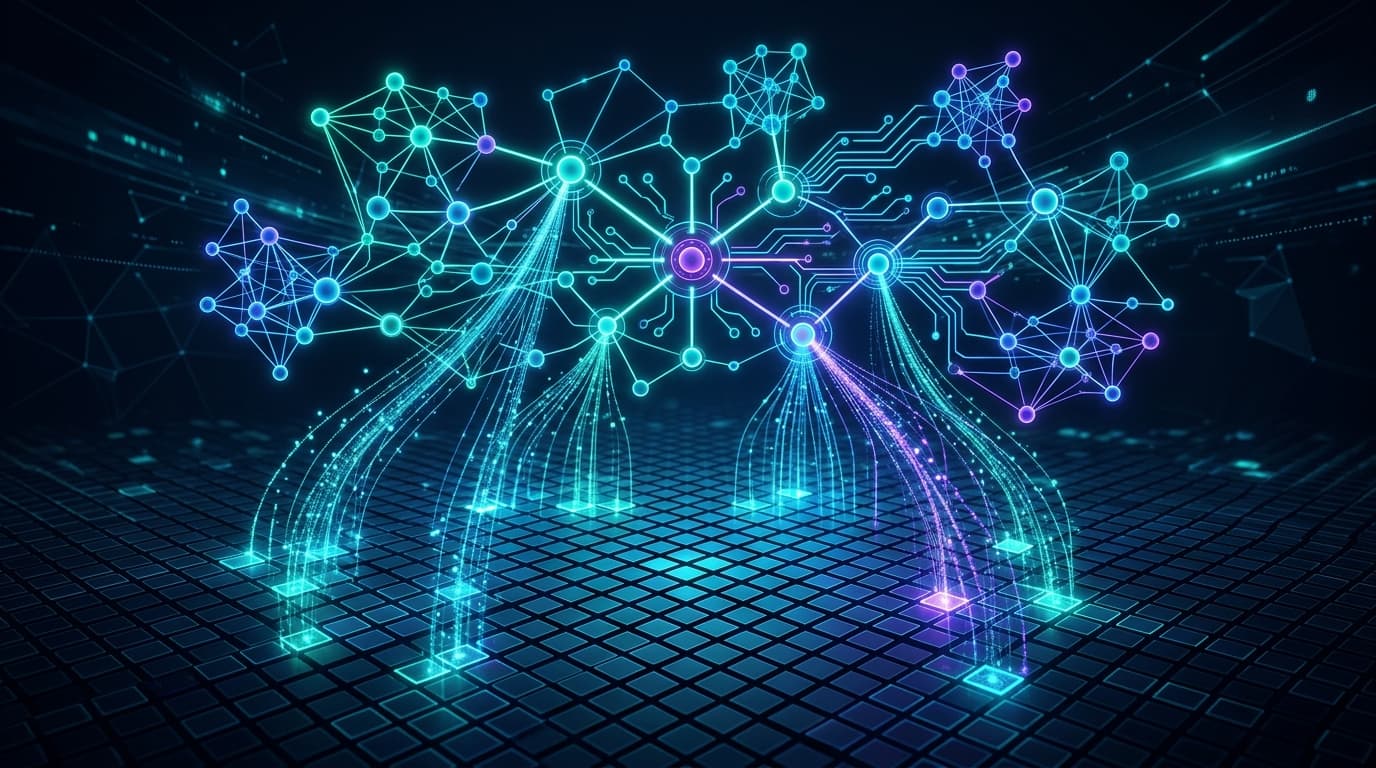
Retrieval-Augmented Generation has become the default architecture for grounding large language models on private data, but plain vector search still struggles with questions that require relationships, chronology, provenance, or multi-hop reasoning. A vector index is excellent at finding semantically similar passages. It is not naturally good at answering questions such as: Which vendors were mentioned by the same customer across three renewal calls? Which incident caused the downstream policy change? Which product risks connect the engineering roadmap to support escalations?
GraphRAG is the answer to that gap. It combines the semantic breadth of vector retrieval with the structural precision of a knowledge graph. Instead of treating documents as isolated chunks, a GraphRAG system extracts entities, relationships, communities, and claims, then uses those structures to guide retrieval before the LLM writes an answer. The result is a retrieval layer that can reason across documents rather than merely finding nearby text.
This article explains how GraphRAG works, why it matters, how to build the architecture, where vector search still belongs, and what production teams should measure before deploying it.
What Is It?
GraphRAG is a retrieval architecture that augments vector search with a graph representation of knowledge. The graph typically contains nodes such as people, companies, products, services, incidents, tickets, tables, APIs, and concepts. Edges represent relationships such as owns, depends on, caused, mentioned in, competes with, blocks, resolves, duplicates, and supersedes. The graph may also include communities, summaries, timestamps, source references, confidence scores, and permissions.
In a traditional RAG pipeline, the system embeds chunks of text, stores vectors in an index, retrieves the top k chunks for a query, and sends those chunks to a language model. In GraphRAG, the system still uses embeddings, but it also constructs a map of relationships. Retrieval can then follow paths through the graph, collect neighboring evidence, expand through relevant communities, and combine that evidence with vector matches.
The key idea is simple: meaning is not only similarity. Meaning also lives in structure. Two chunks may use different words but refer to the same entity. A failure report may not mention the executive summary that depends on it. A policy update may make sense only when connected to the incident that triggered it. GraphRAG gives the retrieval system a way to traverse those connections.
A practical GraphRAG system usually has four layers:
- A document ingestion layer that splits and normalizes source material.
- An extraction layer that identifies entities, claims, and relationships.
- A storage layer that keeps both vectors and graph structures.
- A retrieval orchestration layer that decides when to use vector search, graph traversal, community summaries, or a hybrid of all three.
GraphRAG is not a replacement for vector search. It is a way to make vector search more relational, more explainable, and more useful for questions that span multiple pieces of evidence.
Why It Matters
Plain vector RAG works best when a user asks for information that is located in one or two semantically similar passages. It becomes weaker when the answer depends on connections between documents. This is why a support knowledge base can answer a direct policy question but fail when asked to explain how three escalations relate to a product roadmap item.
GraphRAG matters because production knowledge is rarely flat. Enterprise knowledge looks like a network: customers connect to accounts, accounts connect to contracts, contracts connect to commitments, commitments connect to engineering tasks, and tasks connect to incidents. If the retrieval system ignores those relationships, the LLM receives isolated evidence and fills the gaps with guesses.
GraphRAG also improves debugging. In a basic RAG system, a bad answer is often hard to diagnose. Was the embedding model weak? Was the chunk size wrong? Did the retriever miss an important document? Did the model hallucinate? A graph adds explicit intermediate objects: extracted entities, edges, communities, paths, and source citations. These objects make retrieval behavior more inspectable.
This is especially important when combined with the evaluation techniques described in RAG Evaluation Frameworks: Mathematical Metrics Behind Ragas and TruLens. GraphRAG gives you richer retrieval traces, while evaluation frameworks help measure whether those traces actually improve faithfulness, context relevance, and answer relevance.
GraphRAG also complements Hybrid Search Architectures: Reciprocal Rank Fusion and Cross-Encoder Re-ranking. Hybrid search improves the candidate pool by combining lexical and semantic signals. GraphRAG goes further by adding relational expansion. In strong production systems, these approaches are not competitors; they are stacked.
How It Works
A GraphRAG pipeline starts similarly to a standard RAG pipeline. Documents are loaded, cleaned, chunked, and embedded. The difference begins after chunking. The system also performs information extraction over each chunk. This extraction may be done by an LLM, a named entity recognizer, a schema-guided parser, or a domain-specific model.
The extraction phase usually produces three kinds of data.
First, it extracts entities. These are the objects the system may need to reason about later: products, teams, datasets, tables, services, people, organizations, features, vulnerabilities, policies, and incidents. Entity normalization is critical. If one document says OpenAI, another says Open AI, and another says the vendor, the graph needs to resolve these references where possible.
Second, it extracts relationships. Relationships describe how entities interact. For example, Service A depends on Database B. Incident 432 caused Policy Change C. Customer X requested Feature Y. Model Z was evaluated by Benchmark Q. Each edge should keep provenance: where did the relationship come from, which chunk supported it, when was it extracted, and how confident is the system?
Third, it extracts claims or observations. A claim is a statement that can later be verified or cited. Claims are useful because many production answers require more than entities and edges. For example, an entity edge may say a service depends on a database, but a claim may say the dependency has a 200 millisecond timeout and fails open during regional degradation.
Once the graph is built, retrieval becomes a routing problem. The query is analyzed to decide which retrievers should run. Direct factual questions may use vector search. Relationship questions may start with entity linking and graph traversal. Broad summarization questions may use community summaries. Complex questions often use all of them.
A common GraphRAG retrieval flow looks like this:
User query
  -> query embedding
  -> entity linking
  -> vector candidate retrieval
  -> graph neighborhood expansion
  -> community or path summarization
  -> evidence ranking
  -> prompt assembly
  -> answer generation with citations
The final prompt should not dump the entire graph into the LLM. Instead, it should provide a compact evidence packet: the most relevant chunks, the graph paths that explain relationships, source identifiers, confidence scores, and instructions to answer only from supplied evidence.
Architecture
A production GraphRAG architecture has more moving parts than a basic vector RAG stack. That complexity is justified only if the use case needs relational reasoning. The architecture below is a practical reference design.
Documents and events
        |
        v
Parsing and normalization
        |
        v
Chunking and metadata enrichment
        |
        +----------------------+
        |                      |
        v                      v
Embedding model          Entity and relation extraction
        |                      |
        v                      v
Vector index             Graph store
        |                      |
        +----------+-----------+
                   v
          Retrieval orchestrator
                   |
                   v
        Evidence ranking and packing
                   |
                   v
           LLM answer generation
                   |
                   v
        Evaluation and feedback loop
The vector index can be pgvector, Qdrant, Weaviate, Pinecone, Milvus, or another vector database. The graph store can be Neo4j, Kuzu, FalkorDB, Memgraph, a relational adjacency table, or even a document database for smaller deployments. The best choice depends on query patterns, team skills, operational constraints, and data size.
The retrieval orchestrator is the most important component. It decides how to combine signals. For example, if the query contains named entities, the orchestrator can link them to graph nodes and expand one or two hops. If the query asks for a broad theme, it can search community summaries. If the query asks for exact wording, it can prioritize lexical search. If the query asks a normal semantic question, it can fall back to vector retrieval.
| Layer | Responsibility | Common implementation |
|---|---|---|
| Document store | Keep raw source data and permissions | S3, Postgres, object storage, CMS export |
| Vector index | Retrieve semantically similar chunks | pgvector, Qdrant, Pinecone, Milvus |
| Graph store | Store entities, relationships, claims, communities | Neo4j, Kuzu, Memgraph, relational tables |
| Orchestrator | Choose retrieval strategy and merge candidates | Python service, LangGraph, custom pipeline |
| Evaluator | Measure answer quality and retrieval quality | Ragas, TruLens, custom judge prompts |
A strong implementation keeps the graph and vector layers synchronized. Every node, edge, and chunk should point back to source documents. When a document changes, affected chunks, embeddings, entities, and edges must be refreshed. Without synchronization, GraphRAG becomes a hallucination amplifier because stale relationships look authoritative.
Vector Search vs Graph Traversal
Vector search and graph traversal solve different retrieval problems. Vector search answers: Which passages are semantically close to this query? Graph traversal answers: Which facts are connected to these entities through meaningful relationships?
Vector search is high recall and flexible. It works even when there is no predefined schema. It can find documents with similar phrasing and concepts. However, it does not naturally understand direction, dependency, causality, or hierarchy. It may retrieve the right document but miss the document that explains why the answer is true.
Graph traversal is precise and explainable. It can show why two entities are connected. It can follow dependency chains and causal paths. However, it depends on extraction quality. If the entity linker fails or the graph misses an important edge, traversal may produce an incomplete evidence set.
| Query type | Best first retriever | Why |
|---|---|---|
| What does policy X say? | Vector or lexical search | The answer is likely in one passage |
| Which services depend on database Y? | Graph traversal | Dependency edges are explicit |
| Why did roadmap item Z change? | Graph plus vector | Cause may span incidents, tickets, and planning notes |
| Summarize customer complaints about feature A | Community summaries plus vector search | Needs aggregation across many documents |
| Compare vendor A and vendor B across support tickets | Entity graph plus reranking | Needs entity resolution and evidence grouping |
The best production systems combine both. They retrieve semantically relevant chunks, expand around linked entities, rerank the merged set, and then pack a concise evidence context for the LLM.
Building the Knowledge Graph
The quality of GraphRAG depends on the quality of the graph. Poor extraction creates noisy edges, duplicate entities, and misleading paths. The graph should be built incrementally and evaluated continuously.
Start with a schema, even if it is lightweight. Define the entity types that matter for your domain. For a software company, these may include service, repository, customer, incident, feature, team, database, API, and contract. For healthcare, the schema may include medication, symptom, condition, provider, procedure, and guideline. The schema should constrain extraction enough to reduce noise but not so much that it blocks useful discoveries.
Next, choose an extraction strategy. LLM extraction is flexible and easy to start with, but it can be expensive and inconsistent. Rule-based extraction is cheaper and deterministic but misses implicit relationships. A hybrid approach often works best: deterministic extractors for known identifiers, LLM extraction for semantic relationships, and validation rules for edge quality.
Entity resolution is the hardest part. The system must merge aliases without collapsing distinct entities. Apple the company and apple the fruit are not the same node. A product code and a customer abbreviation may overlap. Use metadata, document source, type constraints, and confidence thresholds to reduce incorrect merges.
Every edge should keep provenance. A graph edge without a source is dangerous. Store the source document, chunk identifier, extraction timestamp, extractor version, confidence, and relationship text. This allows the answer generator to cite evidence and allows engineers to debug extraction errors.
Retrieval Strategies
GraphRAG retrieval is not one algorithm. It is a set of strategies that can be selected depending on the query.
Local graph retrieval starts with entities detected in the user query. The retriever links those mentions to graph nodes, expands neighbors, collects connected chunks, and ranks evidence. This is useful for precise questions about known entities.
Global graph retrieval works at a higher level. The system clusters the graph into communities and generates summaries for each community. When a user asks a broad question, the retriever searches these summaries and drills down into the supporting nodes. This is useful for questions like: What are the main risk themes across our customer escalations?
Path-based retrieval searches for paths between two or more entities. If a user asks how a policy connects to an incident, the system can search for paths that connect the policy node to incident nodes through intermediate entities. The answer can then cite the path.
Hybrid retrieval merges vector candidates, graph candidates, lexical candidates, and reranker scores. This is the most reliable approach for production because no single signal works for every query.
| Strategy | Strength | Weakness | Good use case |
|---|---|---|---|
| Local graph expansion | Precise entity reasoning | Sensitive to entity linking errors | Dependencies, ownership, provenance |
| Global community retrieval | Strong thematic summaries | Can hide source-level details | Executive summaries, trend analysis |
| Path search | Explainable multi-hop reasoning | Expensive on dense graphs | Root cause and causality questions |
| Vector search | Flexible semantic recall | Weak relationship awareness | Direct knowledge base answers |
| Hybrid retrieval | Most robust overall | More tuning complexity | Production assistants |
The retrieval orchestrator should log which strategy was used. Without those traces, GraphRAG is difficult to improve.
Production Deployment Considerations
GraphRAG introduces new operational concerns. The first is cost. Entity and relationship extraction often requires an LLM call over many chunks. If your corpus contains millions of documents, naive extraction can become expensive. Batch processing, caching, incremental updates, and smaller extraction models are essential.
The second concern is latency. Graph traversal can be fast, but retrieval orchestration can become slow if it performs too many expansions, reranking passes, and summarization calls. Keep interactive retrieval bounded. Use precomputed community summaries for global questions. Use strict limits on hop count, edge type, and candidate count.
The third concern is permissions. A graph can accidentally connect information across access boundaries. If a user has access to one document but not another, a graph path may leak the existence of restricted information. Permission filters must be applied not only to chunks but also to nodes, edges, summaries, and cached retrieval traces.
The fourth concern is freshness. Relationships change. Customers churn. Incidents close. APIs get deprecated. If the graph is stale, the model may produce confident but outdated answers. Use document versioning, extraction versioning, and scheduled graph refreshes.
The fifth concern is observability. You need traces that show the query, linked entities, selected graph paths, vector matches, reranker scores, prompt context, answer, citations, and evaluation scores. Without these traces, a GraphRAG system becomes a black box.
Common Mistakes
The most common mistake is building a graph because it sounds advanced, not because the use case requires relational retrieval. If your users mostly ask direct documentation questions, a well-tuned hybrid vector and lexical system may be enough.
Another mistake is extracting too many relationship types. A graph with hundreds of vague edge labels becomes hard to query and hard to evaluate. Start with a small set of high-value relationships. Add new edge types only when they improve answer quality.
Teams also overtrust LLM-extracted edges. Extraction models can hallucinate relationships, especially when chunks contain ambiguous pronouns or dense technical language. Use validation prompts, schema constraints, confidence thresholds, and human review for high-risk domains.
A fourth mistake is ignoring chunk design. GraphRAG still depends on source chunks. If chunks are too small, relationships lose context. If chunks are too large, extraction becomes noisy and expensive. Use the same discipline discussed in Advanced RAG: Hierarchical Node Parsing, Parent-Child Retrievers, and Metadata Pre-Filtering: separate retrieval units from synthesis units.
Finally, teams often forget evaluation. A graph that looks elegant in a visualization may not improve user answers. Measure context relevance, faithfulness, answer relevance, citation accuracy, and latency before declaring success.
Lessons From Production Deployments
Production GraphRAG systems work best when teams start narrow. Choose one workflow where relationships clearly matter. Examples include incident root cause analysis, contract obligation search, fraud network investigation, scientific literature mapping, or customer escalation summarization. Build the graph around that workflow instead of trying to model the entire company.
Keep humans in the loop during the early extraction phase. Review entity merges, edge labels, and sample answers. A small amount of review can reveal systematic extraction problems that automated metrics miss.
Cache aggressively. GraphRAG has multiple reusable intermediate artifacts: entity extraction, edge extraction, embeddings, community summaries, reranker outputs, and evaluation results. Caching reduces cost and makes experiments repeatable.
Use graph summaries carefully. Community summaries are powerful, but they can become lossy. Always keep links to source chunks so the final answer can cite evidence. Summaries should guide retrieval, not replace evidence.
Treat the graph as an index, not a source of truth. The source of truth remains the underlying documents or operational systems. The graph is a derived structure that helps retrieval. This mindset prevents teams from overtrusting extracted relationships.
What Most Articles Miss
Most GraphRAG explainers focus on diagrams and ignore maintenance. The hard part is not drawing a graph. The hard part is keeping it correct as documents change. Every ingestion pipeline needs invalidation rules. When a source document changes, the system must know which chunks, embeddings, nodes, edges, summaries, and cached answers are affected.
Another overlooked issue is negative evidence. GraphRAG can show relationships that exist, but many business questions require knowing that a relationship does not exist. For example: Which critical services have no documented owner? Which customer commitments have no linked engineering task? This requires completeness checks, not just traversal.
A third missing topic is evaluation by retrieval path. In vector RAG, we evaluate retrieved chunks. In GraphRAG, we must also evaluate paths. Did the system choose the right entities? Was the hop count appropriate? Did the path support the answer? Did expansion introduce unrelated evidence? Path-level evaluation is essential for trust.
Finally, many teams underestimate UI requirements. GraphRAG answers should expose citations and sometimes graph paths. Users need to see why the model connected two facts. A hidden graph is less valuable than a graph that improves answer explainability.
Best Practices
Start with a hybrid baseline. Build a strong vector plus lexical plus reranking pipeline first. Then add graph retrieval only where the baseline fails. This makes the value of GraphRAG measurable.
Design a minimal domain schema. Use a small number of entity and relationship types. Require provenance for every edge. Store extraction confidence and extractor version. Avoid unlabeled or ambiguous edges.
Use layered retrieval. First retrieve candidates with vector and lexical search. Then link query entities to graph nodes. Expand only high-confidence nodes. Rerank the merged evidence set. Pack the prompt with source snippets and concise path explanations.
Use strict permission filters. Apply access control before retrieval, during graph traversal, during summary generation, and during prompt assembly. Do not rely on the final LLM to hide restricted data.
Evaluate continuously. Use synthetic and real queries. Track faithfulness, context relevance, answer relevance, citation correctness, path relevance, latency, cost, and user feedback. Regression test the system whenever you change extraction prompts, embedding models, chunking, graph schema, or reranking logic.
FAQ
Is GraphRAG always better than vector RAG?
No. GraphRAG is better when questions require relationships, multi-hop reasoning, aggregation, or explainable paths. For direct documentation lookup, a simpler hybrid search system may be faster and cheaper.
Do I need a graph database?
Not always. Small systems can store nodes and edges in relational tables. A graph database becomes useful when traversal patterns are complex, relationship depth matters, or graph queries are part of the product experience.
Can GraphRAG reduce hallucinations?
It can reduce hallucinations by providing better evidence and explicit relationships, but it does not eliminate them. You still need grounded prompting, citation checks, and evaluation frameworks.
What is the biggest implementation risk?
The biggest risk is noisy extraction. If entities are duplicated or edges are incorrect, the graph can mislead retrieval. Invest in schema design, entity resolution, provenance, and evaluation.
How should GraphRAG be evaluated?
Evaluate both answer quality and retrieval quality. Measure whether selected chunks, entities, and graph paths support the final answer. Combine human review, automated judges, and regression datasets.
Key Takeaways
GraphRAG improves RAG by adding explicit structure to retrieval. It helps systems answer questions that require relationships, dependency chains, causal explanations, and cross-document synthesis.
Vector search remains essential. The strongest systems combine vector retrieval, lexical search, graph traversal, community summaries, reranking, and evaluation.
The graph must be treated as a derived index with provenance, versioning, permissions, and freshness controls. A graph without source links is not trustworthy.
Production GraphRAG is an engineering discipline, not just an architecture diagram. It requires schema design, extraction quality checks, retrieval orchestration, observability, and continuous evaluation.
If your RAG system fails on multi-hop questions, GraphRAG is one of the most practical upgrades. Start narrow, measure carefully, and let the graph earn its complexity.